
Author Archive
Reading a frogman’s battle report…
by Volker on Mar.30, 2026, under Allgemein
One of the rarest historical documents which we came across during the research of our book “History2”: a handwritten battle report of a frogmen mission at the Pomeranian coast, dated April 3rd, 1945.
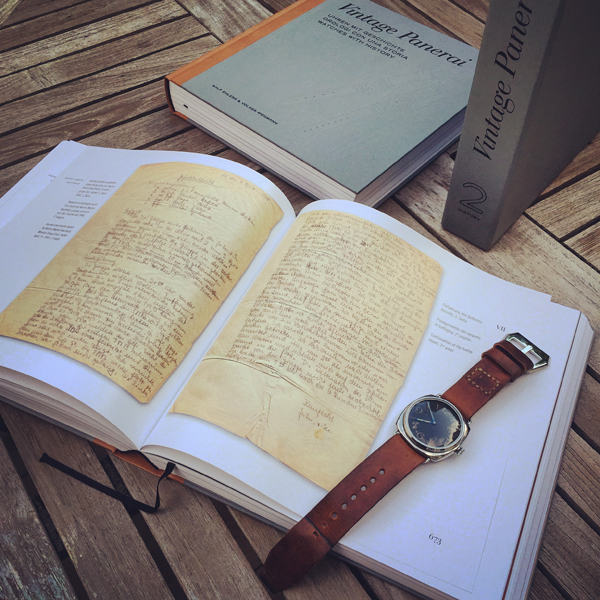 Documents from the last weeks of the Second World War are today, without a doubt, very hard to find – if existing after more than 70 years at all… With the support of the family of the German “Kampfschwimmer”, who once wrote this report after he returned safely from the combat zone, we were able to include this battle report (page 672-673 shown on the coffee table shot on the left) in chapter VII of “History2” (featuring the chapters V-IX with a total of 480 pages).
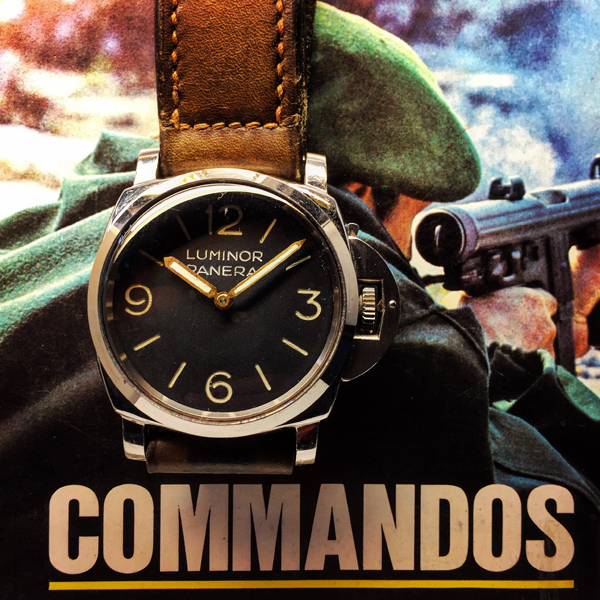
Interesting details in his handwritten battle report are the times which he mentioned aside other details, all easily readable on the sandwich dial of the Ref. 3646 / Type D (with 5 minute markers / indices) he was wearing during the mission: He wrote down 21:50, 23:30, 23:45, 23:50-0:30 and finally 2:05 AM – the moment he left the waters – after 4:15 hours trying to attack the Wollin railroad bridge together with a group of four frogmen from the “Einsatzgruppe Keller”, towing two mines thru the waters of the Dievenow.
One of these five frogmen is featured in our book “History1”. Several pages of his diary are published in chapter II, where he wrote down what happened during the frogmen attack of the Gristow bridge at the Pomeranian coast (page 134-143).
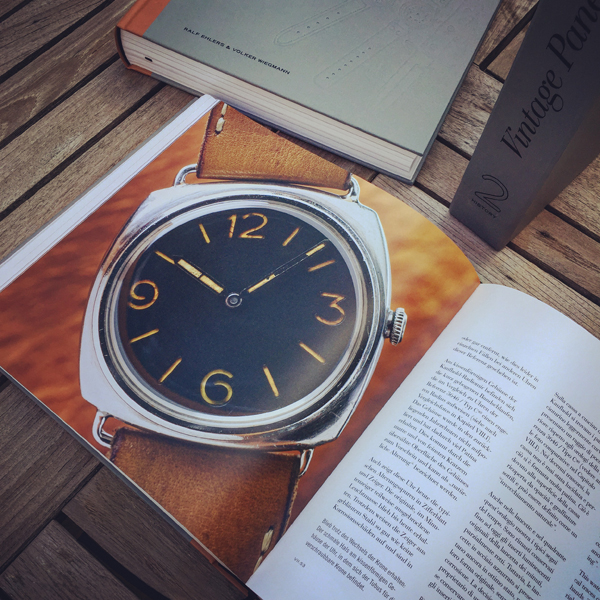 Read more on further rare documents which helped us to capture the history behind the Ref. 3646 / Type D “Kampfschwimmer” watch, shown on the coffee table shot on the left here. Photos from the years 1944 and 1945 showing this watch on the frogman’s wrist, as well as his identification papers and travel documents issued in Venice, helped us to reconstruct the route he took to the mission grounds.
Obviously his handwritten battle report never reached the headquarters but somehow he managed to keep it safe for his personal records, giving us today, more than 70 years later, a detailed inside view on a mission he carried out together with four frogmen at the Eastern Front in April 1945…
Our two “History” books can be ordered only in our bookstore.
Enjoy reading stories behind these watches!
[Ralf Ehlers & Volker Wiegmann]
26 March 1941 – today in history…
by Volker on Mar.26, 2026, under Allgemein
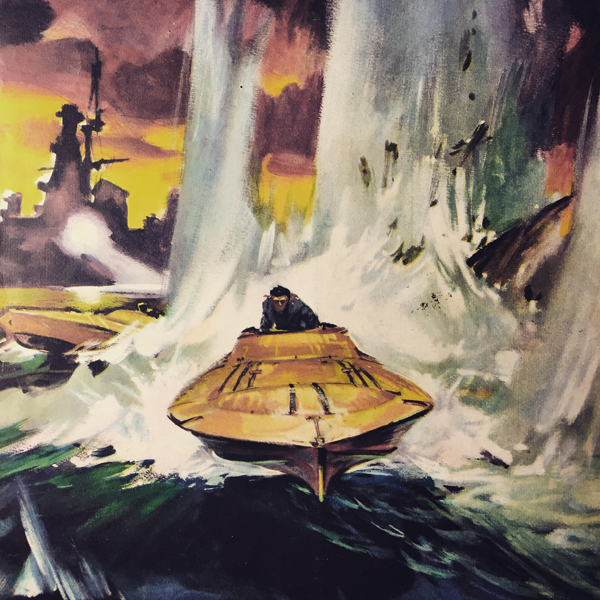 During the winter of 1940-1941 the human torpedo attacks were suspended, at least until the following spring. A detachment of MT explosive boats was based in the Dodecanese, where it trained under the command of Vittorio Moccagatta on the island of Leros with the objective of attacking Souda Bay and the British traffic to Greece.
Vittorio Moccagatta was ordered back to Italy on 23 January 1941, where he became the commander of the 1st MAS Flotilla in La Spezia. His suggestions to the Italian naval commando assumed in the result that the 1st MAS Flotilla became the 10th MAS Flotilla – the Decima MAS – on 15 March 1941, which was divided into two divisions from that time:
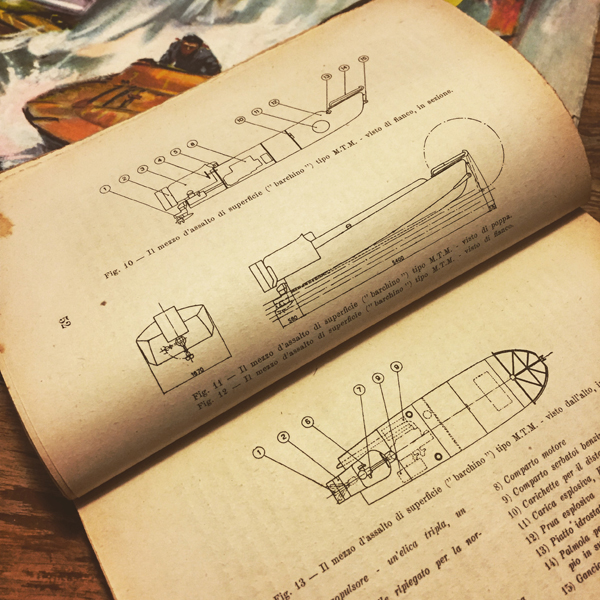 The surface division – Mezzi di Superficie – under the command of Capitano di Corvetta Giorgio Giobbe with a fleet of various explosive boats (category MT, MTM shown by the historic sketches on the left, MTR, MTS, MTMS, SMA, MTL) and motorboats for sabotage operations.
The underwater division – Mezzi Subacquei – under the command of Capitano di Corvetta Junio Valerio Borghese operated the diving School in Livorno, the SLC training base at Bocca di Serchio, the remaining transport submersibles Scirè and Ambra and the frogmen of the “Gruppo Gamma”. On a side note, in early 1941, the two initial transport submersibles for SLC devices, Iride and Gondar, were already lost with the failure of „Operazione G.A.1“ and „Operazione G.A.2“ in August and September 1940.
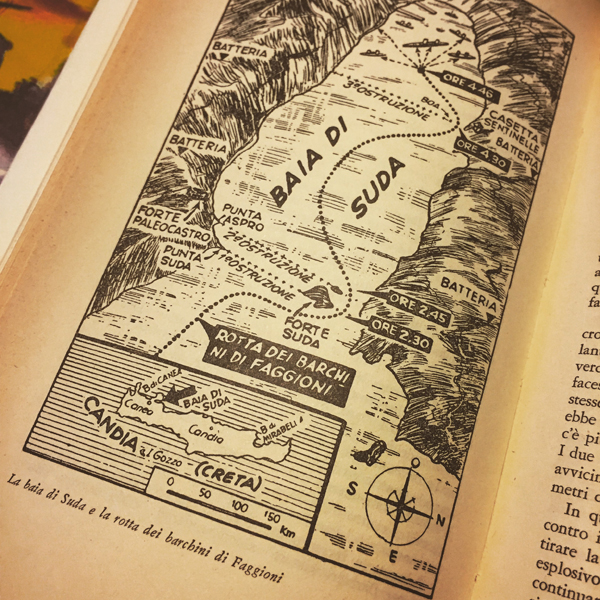 On 26 March 1941, the surface division – Mezzi di Superficie – of the Decima MAS achieved initial successes: six MT-type explosive boats broke through the blockades in Souda Bay (Crete, see historic map on the left) damaging the heavy cruiser York and the tanker Pericles.
During the night, the servicemen Luigi Faggioni (commander), Angelo Cabrini, Tullio Tedeschi, Alessio De Vito, Lino Beccati and Emilio Barberi) were transported to the target area aboard the destroyers Crispi and Sella. These two destroyers were equipped with electrically powered cranes for placement of the MT-type explosive boats on the water, which was carried out in just a few minutes, ten miles from Souda’s entrance, at 2330 hours on 25 March 1941. Unnoticed by the enemy, the MT-type explosive boats managed to cross three barricades and reached their targets in the early hours of the morning of 26 March 1941.
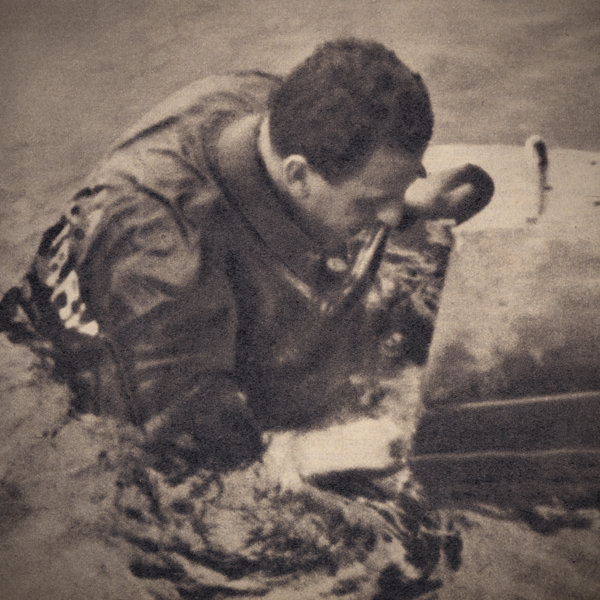
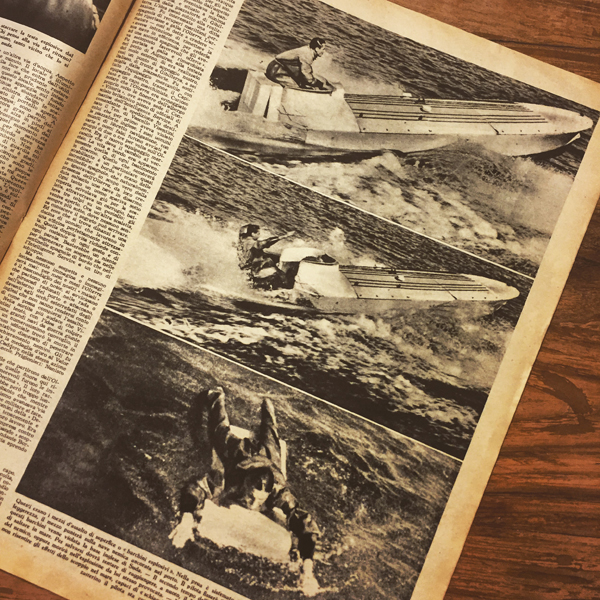 Two MT-type explosive boats attacked the York (the pilots abandoned their boats 80 meters before hitting the ship, see historic photos on the left). Another two MT-type explosive boats attacked the Pericles. Commander Faggioni tried to hit the Coventry but his boat missed the cruiser and exploded on the coast. The sixth MT-type explosive boat missed its target too, but remained intact and was captured by the British. All six pilots of the explosive boats survived the attack and became POW.
Read more about the timeline of the missions during the Second World War in chapter II.I on page 106-146. Vittorio Moccagatta is featured on page 112-113, the attack in Souda Bay is featured on page 108-109.
Restart after the end of the Second World War
by Volker on Feb.13, 2026, under Allgemein
What brought about the demand for new and improved diver’s watches in Italy after the end of the Second World War? The answer to this question is inextricably intertwined with the history of the maritime special units, whose transformation from the Mezzi d’Assalto of the Decima MAS to the COMSUBIN took many years.
 From 1947 to 1951, various divisions and bases were established, restructured and merged, finally settling on COMSUBIN (Comando Subacquei ed Incursori) in 1961. Varignano near La Spezia, headquarters of the COMSUBIN and, as of 1952, was and still is the base for the Scuola Incursori. One of the instructors in the 1950’s was Emilio Barberi M.O.V.M., shown on page 716 (MT explosive boat veteran of the mission against Souda Bay, March 1941, see also page 108-109 in chapter II.I). Read more in the intro of “The References” 1950’s-1960’s on page 705-719. These maritime special units were set up during the same period that Guido Panerai & Figlio was producing watches with the References 6152, 6154, 6152/1 and GPF 2/56, which are documented in chronological order in chapters VI to X. Compasses and depht gauges from these years are following in chapter XI, straps and buckles are closing this second volume of “The References” in chapter XII. Find an overview of all chapters in this book below:
Chapter VI = Reference 6152
(featuring three different watches on page 720-781)
Chapter VII = Reference 6154
(featuring five different watches on page 782-867)
Chapter VIII = Reference 6152/1 with Rolex movements
(featuring fourteen different watches on page 868-1057)
Chapter IX = GPF 2/56
(featuring five different watches on page 1058-1161)
Chapter X = Modified References with Angelus movements
(featuring ten different watches on page 1162-1313)
Chapter XI = Compasses and depth gauges
(featuring fifteen different instruments on page 1314-1367)
Chapter XII = Straps and buckles
(various straps and pin buckles on page 1368-1387)
“The References” books are in stock and ready for shipping – just visit our bookstore and enjoy reading! [Ralf Ehlers & Volker Wiegmann]
Missions and Watches of the Decima MAS
by Volker on Jan.23, 2026, under Allgemein
 Watches from Guido Panerai & Figlio are deeply connected to the history of the Royal Italian Navy during the Second World War. In our book “The References” we have included an overview of the missions of the “Decima” aside the legendary watches, which were an important part of the units of the underwater (“Mezzi Subacquei” / “Gamma” frogmen and SLC) and surface (“Mezzi di Superficie” / explosive boats) special forces of the Decima MAS (“Mezzi d’Assalto”).
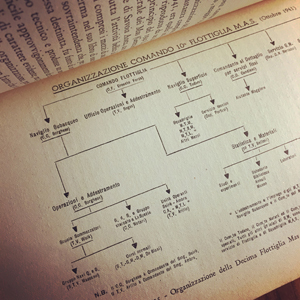
After the disaster at Malta in July 1941 (“Operazione Malta 1”), the Decima MAS was restructured. Capitano di Fregata Ernesto Forza became the new commander of the Decima MAS. The underwater division was given the name of the fallen inventor of the SLC, Teseo Tesei, now commanded by Junio Valerio Borghese. The surface division was given the name of the fallen commander of the Decima, Vittorio Moccagatta, now commanded by Salvatore Todaro (the photo below shows a historical chart of the new structured Mezzi d’Assalto as of October 1941).
 Chapter I and II of the first volume (1930’s-1940’s) carry the history of a new weapon – the SLC slow running torpedo, called “maiale” – and the men who trusted on the watches from Guido Panerai & Figlio during their dangerous missions in deep and darkness of the mediterranean sea. Because of the significance of the fascinating history behind these watches, we have dedicated our book “The References” to the inventors of the SLC, Teseo Tesei and Elios Toschi.
Chapter II of “The References” features some of the rarest Panerai watches owned by famous and high decorated Italian veterans. The first watch of the Reference 3646 / Type A, featured in chapter II.I, belonged to Admiral Ernesto Notari. He was awarded with the Silver Medal for Gallantry at War (M.A.V.M.) for the mission B.G.6 in May 1943.
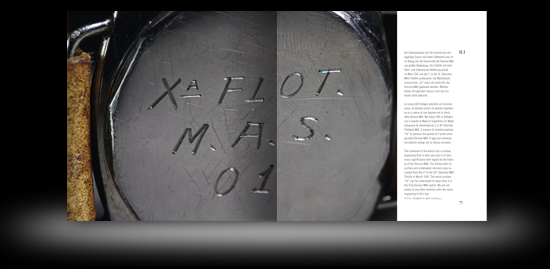
The documentation of the watch (see above page 70-71) and the history of Ernesto Notari, including a summary of the “Mezzi d’Assalto” missions until 8 September 1943 can be read from page 58 to 153 in chapter II.I.
Chapter II.II, about the watches of the Reference 3646 / Type B, features the watch of the legendary “Gamma” frogman Luigio Ferraro. He was awarded with the Gold Medal for Gallantry at War (M.O.V.M.) for his “Stella” missions in the eastern part of the mediterranean sea in 1943.
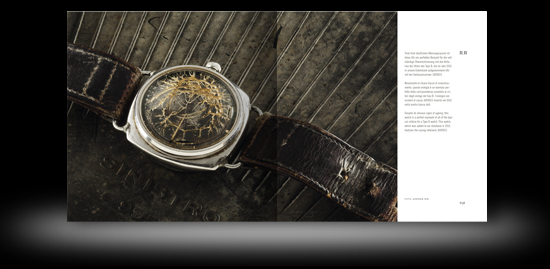
The documentation of the watch (see above page 190-191) and the history of Luigi Ferraro can be read from page 190 to 225 in chapter II.II.
A watch of the Reference 3646 / Type C which belonged to the SLC pilot Licio Visintini is featured in chapter II.III. Visintini took part in several missions against the allied fleet in Gibraltar. After surviving from mission B.G.3 and B.G.4 in 1941, Visintini returned undercover to Gibraltar in June 1942 where he built the core of the “Orsa Maggiore” on board the tanker Olterra – the hidden base for the SLC units of the “Decima” in the bay of Gibraltar. Mission B.G.5 turned into a “mission with no return” for Licio Visintini in December 1942…
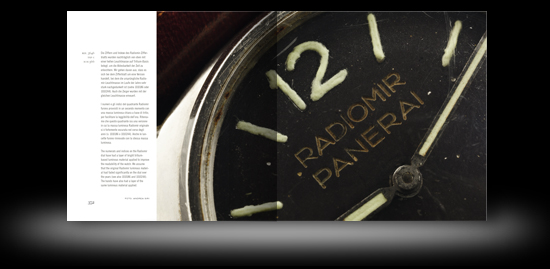
The documentation of the watch (see above page 352-353) and the history of Licio Visintini can be read from page 350 to 397 in chapter II.III.
Information on “The References” 1930’s-1940’s (first volume) can be found here.
Enjoy reading!
[Ralf Ehlers & Volker Wiegmann]
Our database – an interim status on 1 January 2026
by Volker on Jan.03, 2026, under Allgemein
What happened after 1 January 2016 when we “paused” counting new entries in our database for a moment to complete our book set “The References”? We continued to count and still do that – since 2003 (…23 years ago). January 2026 was time to pause again and see how our records have changed in numbers of known watches in our database. The total number of all historic Panerai watches in our database from the 1930’s to the 1960’s has grown to 456 known watches.
Back in 2016 we had 211 entries of the Reference 3646 in our database (seven different number groups, from 3646 / Type A to 3646 / Type G). Since then, 57 watches of the References 3646 have been added into our records, making a total of 268 watches of the reference 3646 today. Find an interim status on 1 January 2026 below:
Reference 2533: 3 examples known (2016: 3)
Reference 3646 / Type A: 18 classified (2016: 18)
Reference 3646 / Type B: 21 classified (2016: 16)
Reference 3646 / Type C: 68 classified (2016: 52)
Reference 3646 / Type D: 108 classified (2016: 79)
Reference 3646 / Type E: 32 classified (2016: 26)
Reference 3646 / Type F: 11 classified (2016: 11)
Reference 3646 / Type G: 10 classified (2016: 9)
Mare Nostrum Chronograph: 1 example known (2016: 1)
The watches made by Guido Panerai & Figlio after the Second World War, those with solid lugs, references 6152, 6154, 6152/1 and GPF 2/56 as well as the transitional references and those with Angelus movements increased from 162 to 183. Most additions are watches of the reference 6152/1 – all four versions (Rolex and Angelus movements, Rolex crown and Panerai crown guard) increased from 103 (2016) to 120 specimen classified in our database on 1 January 2026.
Reference 6152 / Type A: 7 classified (2016: 7)
Reference 6152 / Type B: 2 classified (2016: 2)
Reference 6154: 18 classified (2016: 15)
Reference 6152/1 Rolex with Rolex crown: 25 classified (2016: 23)
Reference 6152/1 Rolex with Panerai crown guard: 75 classified (2016: 64)
GPF 2/56 Angelus: 27 classified (2016: 25)
Reference 3646 Angelus: 5 classified (2016: 5)
Reference 3646 Transitional: 5 classified (2016: 5)
Reference 6152/1 Angelus with Rolex crown: 8 classified (2016: 6)
Reference 6152/1 Angelus with Panerai crown guard: 12 classified (2016: 10)
At this point, again, we want to thank those who shared information on the watches lined up above with us. Auctioneers, collectors, family members of veterans and their friends.
Ralf Ehlers & Volker Wiegmann
Naval heritage – Luigi Ferraro’s Radiomir
by Volker on Dec.26, 2025, under Allgemein
 Without a doubt, Luigi Ferraro was a man whose entire life was shaped by the sea. As a talented swimmer, he had been fascinated by the element of water since his youth. During the Second World War, he became one of the best-known frogmen of all time and showed great courage and skill during his dangerous missions, taking himself into the very limits both physically and mentally.
His Radiomir watch, a Ref. 3646 / Type B with riveted plastic dial, has been with him since he was a “Gamma” frogman in the Second World War. With the kind support of his family we were able to document his watch in chapter II.II of our book “The References” together with a view onto his life – before, during and after the war.
Page 194 – 195: View on the engraved caseback of Luigi Ferraro’s 3646 / Type B.
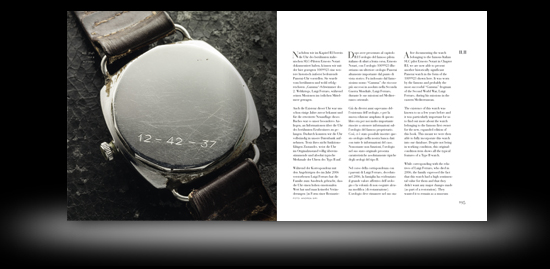
In January 1943, Luigi Ferraro obtained his qualification to carry out underwater missions. He was first posted to North Africa, where he was to attack ships from the British armed forces in the Port of Tripoli. Before the attack could take place, he was ordered back to Italy. Soon later he became an instructor for “Gamma” frogmen of the Mezzi d’Assalto. In May 1943, he was posted to La Spezia and received instructions from Junio Valerio Borghese for a new mission – this time, in the eastern Mediterranean.
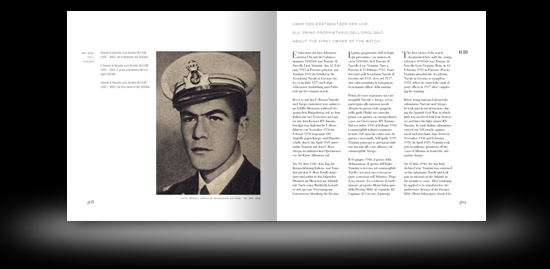
Page 204 – 205: About the first owner of the watch. Luigi Ferraro in uniform, photo dated to 1943. The white collar insignia (with an anchor symbol at the top) show that he is a member of the Mezzi d’Assalto.
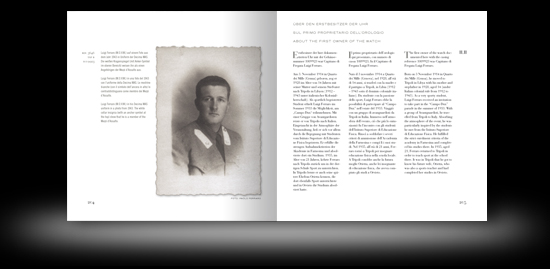
Luigi Ferraro carried out four missions during July and August 1943 in the Turkish ports of Alexandretta and Mersina. These four missions resulted in the sinking of two ships and the deactivation of a third. Undiscovered and highly successful, the “Operazione Stella” was one of the most effective operations of the Mezzi d’Assalto. Luigi Ferraro was awarded with the M.O.V.M. (gold medal for galantry at war) in the rank of Tenente Artiglieria.
Page 210 – 211: Sketch of two of the four “Stella” missions carried out by Luigi Ferraro in Alexandretta.

After his time as a “Gamma” frogman, he used the skills and abilities he had learnt in the war for civilian purposes. He was able to pass on his extensive knowledge and significant experience to countless divers. Luigi Ferraro was promoted by the Marina Militare to Capitano di Fregata di Complemento in the year 2000.
The watch of Luigi Ferraro (1914 – 2006) and the history behind can be read in the book “The References” 1930’s-1940’s (chapter II.II, page 190 to 225). Read more on “Operazione Stella” here. Enjoy reading!
Naval heritage – Licio Visintini’s Radiomir
by Volker on Dec.24, 2025, under Allgemein
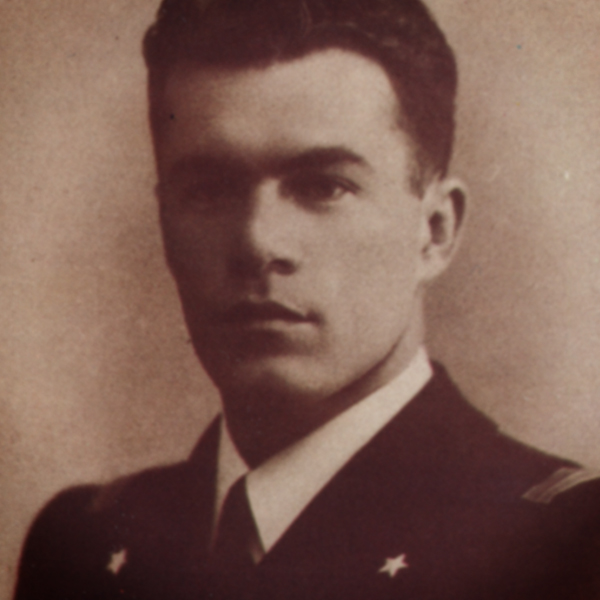 SLC pilot Tenente di Vascello Licio Visintini M.O.V.M. took part on several missions against the allied fleet in Gibraltar as a member of the Mezzi d’Assalto.
After returning from the SLC missions B.G.3, being pilot of SLC 160 in May 1941 and B.G.4, being pilot of SLC 220 in September 1941 (both carried out from the transport submersible “Scirè” under the command of Junio Valerio Borghese), Licio Visintini, twice awarded with the silver medal for galantry at war (M.A.V.M.), returned to Gibraltar undercover in June 1942. He built the core of the “Orsa Maggiore” on board the tanker Olterra – the new, hidden base for the SLC units in the bay of Gibraltar (which remained undiscovered until September 1943). Read more on the Olterra here.
After months of preparations and training in complete secrecy, the SLC mission B.G.5 took progress in December 1942 with three SLC devices of the 200-series: 228, 229 and 236. For Licio Visintini, Giovanni Magro and Salvatore Leone it was a missions with no return. Read the complete story about their fateful SLC mission and how Licio Visintini’s Ref. 3646 / Type C with “Radiomir Panerai” dial returned to Italy and changed ownership two times after, on page 368-397.
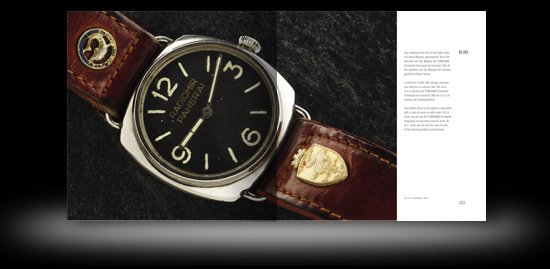
Page 354 – 355: Licio Visintini’s 3646 / Type C. The strap has been decorated with coat-of-arms of the Sommergibilisti (submariners) and COMSUBIN (Raggruppamento subacquei e incursori “Teseo Tesei”). The Rolex movement of the watch has been introduced here.
Page 368 – 369: About the first owner of the watch. Tenente di Vascello Licio Visintini M.O.V.M.
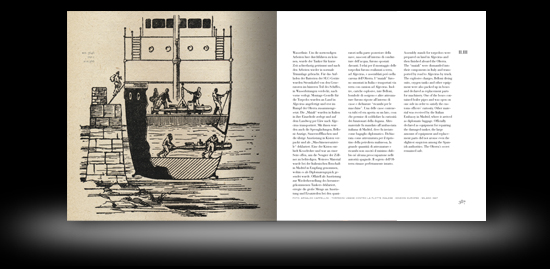
Page 386 – 387: Illustration of the secret SLC base Olterra at the pier in Algeciras / Bay of Gibraltar.
The watch of Tenente di Vascello Licio Visintini (1915 – 1942) and the history behind can be read in the book “The References” 1930’s-1940’s (chapter II.III, page 350 to 397). Read more on Licio Visintini here. Enjoy reading!
Naval heritage – Ernesto Notari’s Radiomir
by Volker on Dec.22, 2025, under Allgemein
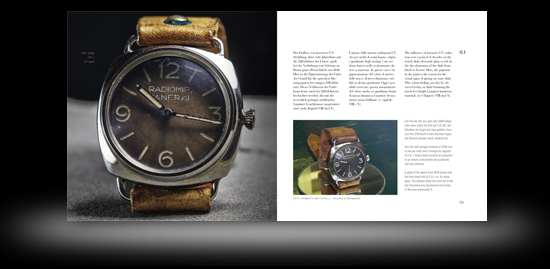
 Since 1992, the Vintage Panerai watch which was worn by SLC pilot Ernesto Notari during the Second World War, is on display at the Museo Tecnico Navale in La Spezia. Back then, the watch’s first owner decided to give the watch to the museum on his own wish. It was accepted into the museum’s inventory and since then, it has been on display in a cabinet with other rare items from the Mezzi d’Assalto, where it is resting on one of the last remaining SLC devices.
In its unaltered original condition, it was an important source of information for us. With the support of the museum we were able to enter all details of the watch into our database. Beside the importance by the history behind, this watch marks the earliest known 3646 / Type A and so became the first watch in chapter II. With its engraved caseback it is of enormous significance with regard to the history of the Mezzi d’Assalto of the Royal Italian Navy.
Page 60 – 61: Comparing photos of Ernesto Notari’s Ref. 3646 / Type A from 2014 and 2008.
Being a member of the Mezzi Subacquei, Ernesto Notari trained at Bocca di Serchio, the secret base of the underwater special unit in Tuscany. In early 1940, the first training exercises were carried out, resulting in the 1935 concept of Teseo Tesei and Elios Toschi evolving into a real, secret weapon. After the desaster of Malta in July 1941, Ernesto Notari was commander of the training base Bocca di Serchio.
In 1943 Notari posted to the secret base in the Bay of Algeciras, the Olterra. After the successful return from mission B.G.6 in May 1943, Notari was awarded with the M.A.V.M. (silver medal for galantry at war) in the rank of Capitano di Corvetta. He solved another successful mission in August 1943: B.G.7, for which he was awarded M.A.V.M. one more time. B.G.7 was the last mission carried out from the tanker Olterra. The declaration of the ceasefire by Italy on 8 September 1943 brought all further plans to an end. The secret of the Olterra was only discovered by the British in October 1943. The undercover missions of the Decima MAS in Gibraltar were therefore highly successful. Although they did not have any major successes like in Alexandria, the continued presence of the Decima for a period of almost three years exercised constant pressure on the British. The use of Villa Carmela and the Olterra as secret starting bases for night-time missions showed the decisiveness of the Decima MAS and its courageous men – one of whom was Ernesto Notari.
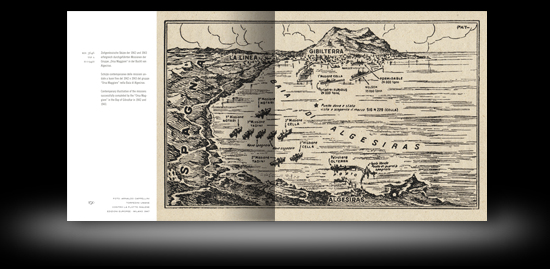
Page 150 – 151: Illustration of the missions completed by the “Orsa Maggiore” in the Bay of Algeciras in 1942 and 1943.
After the Second World War, Ernesto Notari continued his career with the Marina Militare. As a Capitano di Fregata, he commanded the reformed special unit from 10 October 1947 to 25 September 1948. As a Capitano di Vascello, Notari served his second captaincy from 1 October 1950 to 14 March 1951. In 1952, he assumed command of the Sezione Tecnica Autonoma in Bacoli. The secret base in the province of Naples existed from 1949 to 1957 before being moved to Varignano as part of a restructuring process . This site was home to some of the remaining Mezzi d’Assalto equipment. By the end of his Navy career, Ernesto Notari had reached the rank of Vice-Admiral (Ammiraglio di Squadra).
Page 92 – 93: About the first owner of the watch, Admiral Ernesto Notari, photo taken after the Second World War.
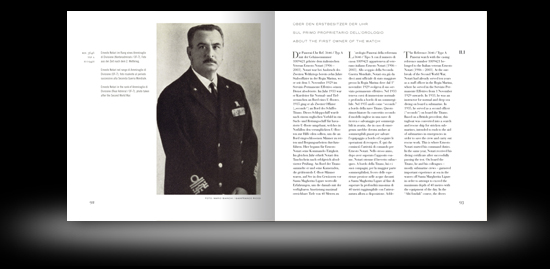
The watch of Ernesto Notari (a Ref. 3646 / Type A with „Radiomir Panerai“ dial) and the history behind can be read in the book “The References” 1930’s-1940’s (chapter II.I, page 58 to 153). Read more on the Olterra here. Enjoy reading!
Inventors, pilots and a royal visitor…
by Volker on Dec.21, 2025, under Allgemein
The first watches for the pilots of the “new weapon” SLC were delivered in the middle of the 1930’s by Guido Panerai & Figlio to the Commando del 1° Gruppo Sommergibili of the Royal Italian Navy. According to the timeline of the development of the top secret slow running torpedos (siluro a lenta corsa, short: SLC) by the inventors Teseo Tesei and Elios Toschi, waterproof and luminous instruments for the pilots were necessary to carry out proper exercises and to control the SLC in depth and darkness.
 The chapters I and II, dedicated to the first watches for underwater use (Ref. 2533 and 3646) take the readers of our book “The References” 1930’s-1940’s into these early years. Teseo Tesei and Elios Toschi’s ideas became real. But strategic decisions after the Italo-Ethiopian War stopped the secret SLC project. The tests with these small weapons were archived and the Royal Italian Navy focused their interest in huge battleships, cruisers and destroyers.
The SLC project was re-started by the 1st Flottiglia MAS in 1939 at the advent of the Second World War. With the first missions of the Mezzi d’Assalto carried out from August 1940 onwards, the demand for skilled operators as well as new equipment – and more instruments for the operators – grew fast. An early Ref. 3646 / Type A, dated to April 1940, is featured in chapter II.I followed by the timeline of the missions carried out by the operators of the Decima Flottiglia MAS, the special commandos of the Royal Italian Navy.
 The photo shows page 96 of “The References” with a historic photo from June 1940: The two inventors of the SLC, Teseo Tesei and Elios Toschi, Alberto Franzini and Gino Birindelli above their co-pilots stand together with a royal visitor: Principe Aimone di Savoia Aosta, Duca di Spoleto – just a few weeks before the first missions of the new weapon SLC were about to write naval history.
Read more about “The birth of a legend – the first Panerai watches (1935-1939)” in chapter I, followed by the timeline of the missions during the Second World War in chapter II.I – more information on the historic content in our “The References” book set with a total of 1392 pages can be found here. Read about the featured watches from Guido Panerai & Figlio in the first and second volume here.
18 December 1941 – today in history…
by Volker on Dec.18, 2025, under Allgemein
After the failed missions in August and September 1940, the Decima MAS returned to the eastern Mediterranean in order to make another attemp to attack the Harbour of Alexandria with SLC devices of the Mezzi d’Assalto: “Operazione G.A.3”, carried out by Tenente di Vascello Luigi Durand de la Penne and Capo Palombaro I Emilio Bianchi (SLC 221), Capitano Genio Navale Antonio Marceglia and Sottocapo Palombaro Spartaco Schergat (SLC 222), Capitano Armi Navale Vincenzo Martellotta and Sottocapo Palombaro Mario Marino (SLC 223).
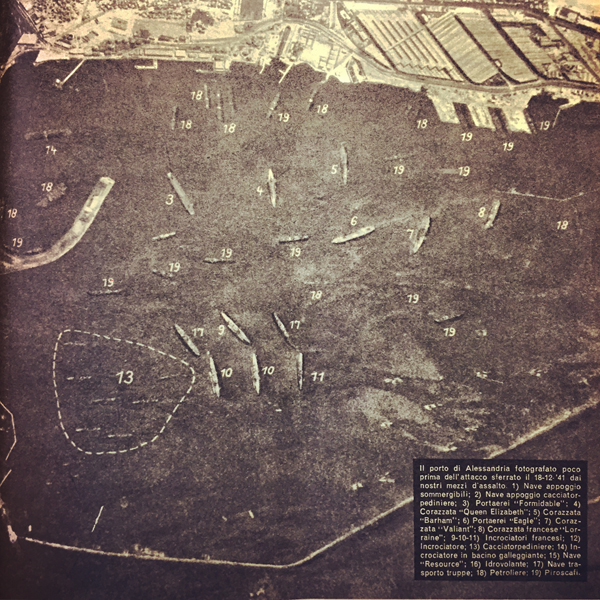 What turned out to be one of the most famous SLC missions in the Second World War has been announced in the Italian War Bulletin N. 585 of the 8th of January 1942: “On the night of the 18th December assault craft of the Italian Royal Navy entered the Harbour of Alexandria and attacked two British battleships anchored there. It has only just been confirmed that a battleship of the Valiant class was seriously damaged and put into dock for repairs, and is still there.”
Bulletin N. 586 of the 9th of January 1942, added the following: “In the Operation conducted by assault craft fo the Royal Italian Navy in the Harbour of Alexandria and reported in yesterday’s Bulletin we now have definite further intelligence that, in Addition to the Valiant, a second battleship of the Barham class was also damaged.”
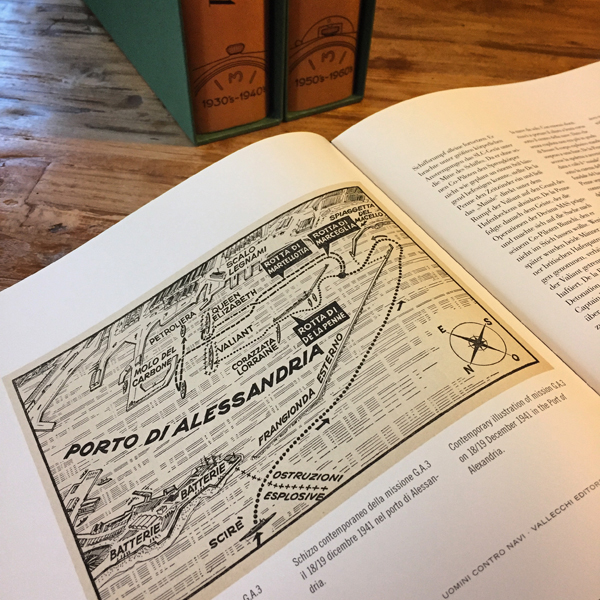 Winston Churchill announced in a speech before a secret session of the House of Commons on the 23rd of April 1942: “A further sinister stroke was to come. On the early morning of December 19 half a dozen Italians in unusual diving suits were captured floundering about in the Harbour of Alexandria… Four hours later explosions occurred in the bottoms of the Valiant and the Queen Elizabeth, produced by limpet bombs fixed with extra-ordinary courage and ingenuity, the effect which was to blow large holes in the bottoms of both ships and to flood several compartments, thus putting them both out of Actions for many months…”
Read chapter II.I of our book “The References” 1930’s-1940’s to find out what happened on 18 December 1941 (page 118-125). More on the historic content in our “The References” book set with a total of 1392 pages can be found here and here. You can purchase “The References” 1930’s-1940’s in our bookstore. Enjoy reading!
Products
-
 Complete Library 4 Volumes
€856.00€685.00 -
 Watches with History 2 Volumes
€378.00€340.00 -
 The References 2 Volumes
€478.00€430.00 -
 "The References" 1930's-1940's
€239.00
"The References" 1930's-1940's
€239.00
-
 "The References" 1950's-1960's
€239.00
"The References" 1950's-1960's
€239.00
-